Offered is a ladder badge worn by one of the hard fighting western regiments, the 12th Missouri Infantry. The badge has four ladders and a tassel.
Detailed service
Fremont's advance on Springfield, Missouri, September to November 1861. Moved to Jefferson City, thence to Sedalia and Springfield.
To Wilson's Creek October 6–8. Duty at Rolla until January, 1862 Expedition to Danville December 26, 1861. Curtis' Campaign in Missouri and Arkansas against Price January to March 1862. Advance on Springfield February 2–16. Pursuit of Price into Arkansas February 14–29. Battles of Pea Ridge, Arkansas, March 6–8. March to Batesville April 5-May 3; thence to Helena, Arkansas, May 25-July 14. Expedition from Helena to mouth of White River August 5–8. Moved to Ironton-Pilot Knob, Missouri, September 1. To St. Genevieve November 12, and return to Helena November 23. Sherman's Yazoo Expedition December 22, 1862, to January 3, 1863. Chickasaw Bayou December 26–28. Chickasaw Bluff December 29. Expedition to Arkansas Post, Arkansas, January 3–10, 1863. Assault and capture of Fort Hindman, Arkansas Post, January 10–11. Moved to Young's Point, La., January 17–23. Duty there until March and at Milliken's Bend until April. Expedition to Greenville, Black Bayou and Deer Creek April 2–14. Demonstration on Haines and Drumgould's Bluffs April 29-May 2. Moved to join army in rear of Vicksburg, Mississippi, via Richmond and Grand Gulf May 2–14. Mississippi Springs May 12–13. Jackson May 14. Siege of Vicksburg, Mississippi, May 18-July 4. Assaults on Vicksburg May 19 and 22. Advance on Jackson, Mississippi, July 4–10. Siege of Jackson July 10–17. Bolton's Depot July 16. Brier Creek, near Canton, July 17, Clinton July 18. Camp at Big Black until September 27. Moved to Memphis, Tennessee, thence march to Chattanooga, Tennessee, September 27-November 21. Operations on Memphis & Charleston Railroad in Alabama October 20–29. Cherokee Station October 21 and 29. Cane Creek October 26. Tuscumbia October 26–27. Battles of Chattanooga November 23–27. Lookout Mountain November 23–24. Mission Ridge November 25. Ringgold Gap, Taylor's Ridge, November 27. March to relief of Knoxville, November 28-December 8. Garrison duty in Alabama at Woodville and Scottsboro, Alabama, and at Cleveland, Tennessee, to May 1864. Atlanta (Georgia) Campaign May 1 to September 8. Demonstration on Resaca May 8–13. Battle of Resaca May 13–15. Advance on Dallas May 18–25. Battles about Dallas, New Hope Church and Allatoona Hills May 25-June 5. Operations about Marietta and against Kenesaw Mountain June 10-July 2. Bushy Mountain June 15–17. Assault on Kenesaw June 27. Nickajack Creek July 2–5. Chattahoochie River July 6–17. Battle of Atlanta July 22. Siege of Atlanta July 22-August 25. Ezra Chapel, Hood's 2nd Sortie, July 28. Flank movement on Jonesboro August 25–30. Lovejoy Station September 2–6. Pursuit of Hood into Alabama October 1–21. Mustered out by Companies from August 12 to November 14, 1864. Consolidated with Detachments from 3rd and 17th Missouri Volunteer Infantry and subsequently transferred to 15th Missouri Infantry.
Offered is a ladder badge worn by members of the 149 Pennsylvania Infantry at their reunions. This four piece ladder badge is a hard one to find. Each soldier wore a buck tail on their hat as a symbol of marksmanship. The regiment was particularly decimated at the battle of Gettysburg.
Offered is a great badge worn by veteran members of the 150th New York Infantry at their 1899 reunion. The badge has a brass colored metal hanger. A yellow ribbon is attached. Written on the ribbon is silver colored ink is "150th N.Y. Vol. Regimental Association - October 11th, 1899". The badge was made by the J.E. West & Co. Manufacturers, Poughkeepsie, N.Y. as noted by the manufacturer's label on the back of the ribbon.
Offered is a wonderful badge worn by members of the 16th Maine Infantry. The badge has a Fifth Corp badge as the hanger. Attached is a blue ribbon with "16th Maine Reg't Association" written in a gold ink. At the bottom of the ribbon is a white circle of cloth applied to the badge representing the 16th Maine's time in the 1st Corps. A fringe is attached to the blue ribbon. A T-bar pin is attached to the back of the 5th Corp hanger.
The 16th Maine was organized at Augusta, Maine, and mustered into Federal service for a three-year enlistment on August 14, 1862. It departed for Washington, D.C. in 1862. Likely assigned to 3rd Brigade, 2nd Division, 3rd Army Corps, Army of Virginia, to September, 1862. Assigned to 3rd Brigade, 2nd Division, 1st Army Corps, Army of the Potomac, to May, 1863. 1st Brigade, 2nd Division, 1st Army Corps, to March, 1864. 1st Brigade, 2nd Division, 5th Army Corps, to June, 1864. 1st Brigade, 3rd Division, 5th Army Corps, to August, 1864 or later. 2nd Brigade, 3rd Division, 5th Army Corps by February 7, 1865 to April 9, 1865, or perhaps to June, 1865.
16th Maine Volunteer Infantry Regiment
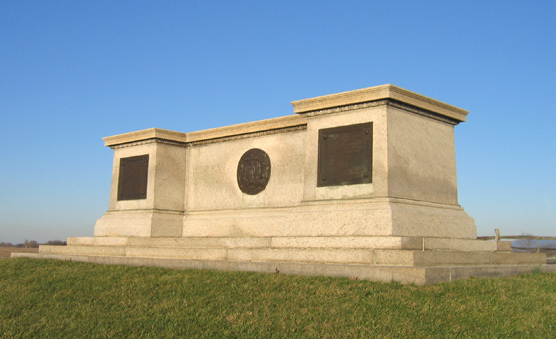
The 16th Maine Volunteer Infantry Regiment lost 9 officers and 172 enlisted men killed or mortally wounded and 2 officers and 257 enlisted men to disease during the Civil War. The regiment is honored by a monument at Gettysburg.
1862
August 14
Organized at Augusta and mustered in
August 19
Left State for Washington, D.C. and camp at Arlington Heights
The 16th Maine was commanded by Colonel Charles W. Tilden, who was captured with most of the regiment when it acted as the rear guard for the division on July 1st. Captain Daniel Marston then took over command of the survivors.
From the monument:
July 1st, 1863, fought here from 1 o’clock until 4 p.m. when the division was forced to retire, by command of General Robinson to Col. Tilden, the regiment was moved to the right near the Mummasburg Road, as indicated by a marker there, with orders ‘to hold the position at any cost.’ July 2d & 3d, in position with the division of Cemetery Hill.
Offered is a great large pin back with a Monitor on it. This is a large pin back at 2 1/8 inches wide. It has good color. It is made by the Whitehead & Hoag Company, New York Office, 253 Broadway, New York as noted by the manufacturer's label.
1 New York Dragoons at 1897 GAR National Encampment Badge
Item #: RX37710
Click image to enlarge
Offered is a nice badge worn by veterans of the 1st New York Dragoons at the 1897 Grand Army of the Republic National Encampment held at Buffalo, New York. The badge has a hanger bar with a yellow ribbon attached. In gold print approximately 5/8 of the way down the badge is two crossed sabers with 1st N.Y. Dragoons. written around it. Also written in black ink on the badge is "Grand Army of the Republic, Buffalo, New York, August 23 to 28, 1897 - Camp Gibbs. Headquarters, 1430 Main Street.". A metal fringe is attached to the bottom of the ribbon.
First New York Dragoons. — Cols., Alfred Gibbs, Thomas J. Thorp; Lieut.- Cols., Thomas J. Thorp, Rufus Scott; Majs., Rufus Scott, Jacob W. Knapp, Howard M. Smith. This regiment was organized in the summer of 1862 at Portage, as the 130th infantry and served as such at Suffolk, Va., and in Keyes' corps on the Peninsula. The companies of which it was composed were recruited in the counties of Allegany, Livingston and Wyoming. It was mustered into the U. S. service at Portage, Sept. 2, 1862, for three years. On July 28, 1863, it was transferred to the mounted service, and designated the 19th cavalry on Aug. 11, but this designation was changed on Sept. 10, to 1st regiment of dragoons. The regiment — ten companies — left the state on Sept. 6, 1862, and served as above noted. During its entire mounted service it was in the 1st cavalry division, Army of the Potomac. It was drilled in its new duties by Col. Gibbs, who belonged to the U. S. cavalry service, and as a regiment of dragoons made its first fight near Manassas Junction in Oct., 1863, sustaining a loss of 10 killed, wounded and missing. The regiment moved on Grant's campaign of 1864 with about 400 carbines and fought desperately in the Wilderness (at Todd's tavern), dismounted, sustaining a loss of 20 killed, 36 wounded and 35 missing, the heaviest loss of any cavalry regiment in any one action during the war. It took part with loss in Gen. Sheridan's raid to the James river in May; at Cold Harbor the tired troopers were aroused from their sleep on the ground and ordered into the breastworks, which they gallantly defended throughout the night, inspired by the music of their band. The losses at Cold Harbor aggregated 35 killed, wounded and missing. Sadly reduced in numbers, the gallant dragoons moved with Sheridan on the raid to Trevilian Station, where they were warmly engaged, their casualties in that action amounting to 16 killed, 61 wounded, and 8 missing. The regiment fought with Sheridan in the Shenandoah Valley and shared in the glories of the final Appomattox campaign. It gained a high reputation among brigade and division generals for discipline and efficiency. Under command of Col. Thorp, it was mustered out and discharged on June 30, 1865, at Cloud's mills, Va., having participated in about 65 battles and skirmishes. It lost 4 officers and 127 men killed and mortally wounded; 1 officer and 142 men by disease, accident, in prison, etc.; a total of 274. Its loss in killed and mortally wounded was exceeded by only five cavalry regiments in the service. Corp. Chester B. Bowen; Com.-Sergt. Andrew J. Lorish and Lieut. William M. Winegar were awarded medals of honor for gallantry in action.
Footnotes: Regimental history taken from "The Union Army" by Federal Publishing Company, 1908 - Volume 2
Offered is a neat badge worn by members of the 21st Michigan Infantry at their 37th Annual reunion. The badge consists of a celluloid pin with the likeness of the membership badge of the Grand Army of the Republic on it. Attached to the right side is a red, white, and blue ribbon. Written on the ribbon is "37th Annual Reunion - 21st Michigan Infantry". The badge is made by the Whitehead & Hoag Company of Newark, New Jersey as noted by the stamping on the back of the pin. The ribbon is supported by a small piece of acid free tape to support the connection to the pin.
21st Michigan Infantry Regimental History
Twenty-first Michigan Infantry. — Cols., Ambrose A. Stevens, William H. McCreery; Lieut. -Cols., William L. Whipple, Morris B. Wells, Loomis K. Bishop; Majs., Isaac Hunting, Seymour Chase, Benton D. Fox. This regiment was organized at Ionia and was mustered in Sept. 4, 1862. It left the state Sept. 12, reported at Cincinnati, was sent to Louisville, entered upon the march through Kentucky, and was in the battle of Perryville, rendering efficient service. It reached Nashville Nov. 12, and joined the advance towards Murfreesboro, being engaged at Lavergne, Stewart's creek and at Stone's river, where it lost 17 killed, 85 wounded and 37 missing. It was with Sill's brigade, Sheridan's division, which blocked the enemy and saved the army. It remained on picket and guard duty at Murfreesboro until June, when it moved to Tullahoma, and was afterward stationed at Cowan, Anderson's station and Bridgeport. On Sept. 2, it advanced into Georgia, participated in the battle of Chickamauga, with the same brigade as at Stone's river, and was in the hottest of the fight after the breaking of the line by Longstreet. Sheridan's division was forced back, but in good order, and by a charge drove the enemy back and regained its position. Being unsupported, it was again driven back, the 21st losing 11 killed, 58 wounded, 35 missing and 3 prisoners. It was detached to form part of the engineer brigade and was engaged in that work during the engagement at Missionary ridge. It was stationed near Chattanooga until June, 1864, building a bridge and erecting storehouses. On June 11 it was ordered to Lookout mountain, engaging in building hospitals, running mills, and on picket duty. It was relieved from engineer duty in September and joined Rousseau's forces in pursuit of Forrest into Alabama. It was ordered to Chattanooga, and Dalton, Ga., in October, and received orders on Nov. 1 to join the 2nd brigade, 1st division, 14th army corps, for the march to the sea. It moved to Milledgeville, then toward Augusta, but changed its course and marched to Savannah, where the regiment was in the trenches on short rations and without covering until Dec. 18. After the evacuation it refitted for the Carolina campaign, proceeded to Sister's ferry, where it crossed the Savannah river Feb. 5, was in the engagement at Averasboro, and was heavily engaged at Bentonville, losing 92 officers and men killed and wounded out of 230. It reached Goldsboro on March 25, after a 64 days' march, with an issue of but 12 days' rations. It moved to Haywood, where it remained until Johnston's surrender and then marched to Richmond, 280 miles, in less than 8 days. It participated in the grand review at Washington and was mustered out June 8, 1865. Its original strength was 1,108: gain by recruits 369; total 1,477. Loss by death, 368.
Footnotes: Regimental history taken from "The Union Army" by Federal Publishing Company, 1908 - Volume 3
1904 Indiana Grand Army of the Republic State Pin Back
Item #: RX35855
Click image to enlarge
Offered is a nice pin back from the 1904 Grand Army of the Republic Indiana State Encampment held in Warsaw - Winona, Indiana. The pin back has a scene of Lake Winona on it. Written around the scene is "Warsaw - Winina - 25th Enc'mt Indiana G.A.R. - 1904". The pin back is approximately 1 1/4 inches wide.
A super badge worn by Massachusetts veterans at the 1898 Massachusetts monument dedication at Antietam battle field. The hanger and the drop are made of a bronze type metal. Written on the hanger is "MASSACHUSETTS". A off white ribbon is attached to the hanger. The drop is attached to the ribbon. On the drop is the coat of arms of the State of Massachusetts. Written on the back of the drop is "Dedication . Antietam. Monument. - Antietam. MD. 1898.". Photos not included.
McMillen Post No. 122, South Charleston, Ohio Pin Back
Item #: RX31014
Click image to enlarge
A nice pin back worn by Union veterans who were members of the McMillen Post No. 122 of South Charleston, Ohio. The pin back has a woman holding a U.S.flag putting a wreath on a G.A.R. monument. Written around the graphics is "McMillen Post No. 122, Ohio". The badge was made by the Sommer Badge Manufacturing Company of Newark, New Jersey as noted in the back of the pin back. The pin is approximately 1 1/4 inches wide.
A nice pin back worn by G.A.R. members who supported DeWitt C. Hurd of New York for the Department of New York Commander. DeWitt C. hurd was in the 10th New York Heavy Artillery from 1862 until 1865. This neat pin has a photo likeness of Hurd in the middle of the pin. Written around the photo likeness is "For Department Commandr G.A.R. - DeWitt C. Hurd". The badge was made by the Sommer Badge Manufacturing Company, Newark, New Jersey. The pin back is approximately 1 3/4 inches wide.
Dewitt C. Hurd
Residence was not listed; 21 years old.

Enlisted on 8/8/1862 at Ellisburgh, NY as a Private.

On 8/19/1862 he mustered into "E" Co. NY 10th Heavy Artillery
He was Mustered Out on 6/23/1865 at Petersburg, VA


Promotions:
* Qtr Master Serg 9/11/1862
* Sergt Major 2/14/1865


Intra Regimental Company Transfers:
* 9/11/1862 from company E to Field & Staff


Sources used by Historical Data Systems, Inc.:
A nice pin back with the likeness of Captain Marshall W. Wright of the 105th Ohio Infantry. Written around the likeness of Captain Wright is "Capt. M.W. Wright, Q.M. 105th O.V.I.". The pin back is approximately 1 1/4 inches wide. It was made by the Ehrman Manufacturing Company of Boston, Massachusetts as noted on the back of the pin back.
105th Ohio Volunteer Infantry
From Dyer's Compendium
105th Regiment Infantry. Organized at Cleveland, Ohio, and mustered in August 20, 1862. Ordered to Covington, Ky., August 21, 1862; thence to Lexington, Ky., August 25. March to relief of Nelson August 30. Retreat to Louisville, Ky., September 1-15. Attached to 33rd Brigade, 10th Division, Army of the Ohio, to September, 1862. 33rd Brigade, 10th Division, 2nd Corps, Army of the Ohio, to November, 1862. 1st Brigade, 5th Division (Centre), 14th Army Corps, Army of the Cumberland, to January, 1863. 1st Brigade, 5th Division, 14th Army Corps, Army of the Cumberland, to June, 1863. 2nd Brigade, 4th Division, 14th Army Corps, to October, 1863. 2nd Brigade, 3rd Division, 14th Army Corps, to July, 1865. SERVICE.--Pursuit of Bragg into Kentucky October 1-12. Battle of Perryville, Ky., October 8. March to Munfordsville, Ky., October 12, and duty there till November 30. Expedition to Cave City October 31 and November 26. Moved to Bledsoe Creek November 30. Operations against Morgan December 22, 1862, to January 2, 1863. March to Nashville, Tenn., thence to Murfreesboro January 3-11, and duty there till June. Expedition to Auburn, Liberty and Alexandria February 3-5. Expedition to Woodbury March 3-8. Vaught's Hill, near Milton, March 20. Expedition to McMinnville April 20-30. Middle Tennessee (or Tullahoma) Campaign June 23-July 7. Hoover's Gap June 24-26. Occupation of Middle Tennessee till August 16. Passage of the Cumberland Mountains and Tennessee River and Chickamauga (Ga.) Campaign August 16-September 22. Shellmound August 21. Reconnoissance toward Chattanooga August 30-31. Battle of Chickamauga September 19-21. Siege of Chattanooga, Tenn., September 24-November 23. Chattanooga-Ringgold Campaign November 23-27. Orchard Knob November 23-24. Mission Ridge November 25. Demonstrations on Dalton, Ga., February 22-27, 1864. Tunnel Hill, Buzzard's Roost Gap and Rocky Face Ridge February 23-25. Reconnoissance from Ringgold toward Tunnel Hill April 29. Atlanta (Ga.) Campaign May 1 to September 8. Demonstrations on Rocky Face Ridge May 8-11. Battle of Resaca May 14-15. Advance on Dallas May 18-25. Operations on line of Pumpkin Vine Creek and battles about Dallas, New Hope Church and Allatoona Hills May 25-June 5. Operations about Marietta and against Kenesaw June 10-July 2. Pine Hill June 11-14. Lost Mountain June 15-17. Assault on Kenesaw June 27. Ruff's Station July 4. Chattahoochie River July 5-17. Peach Tree Creek July 19-20. Siege of Atlanta July 22-August 25. Utoy Creek August 5-7. Flank movement on Jonesboro August 25-30. Battle of Jonesboro August 31-September 1. Operations against; Hood in North Georgia and North Alabama September 29-November 3. March to the sea November 15-December 10. Siege of Savannah December 10-15. Campaign of the Carolinas January to April, 1865. Fayetteville, N. C., March 11. Battle of Bentonville March 19-21. Occupation of Goldsboro March 24. Advance on Raleigh April 10-14. Occupation of Raleigh April 14. Bennett's House April 26. Surrender of Johnston and his army. March to Washington, D.C., via Richmond, Va., April 29-May 20. Grand Review May 24. Mustered out June 3, 1865. Regiment lost during service 3 Officers and 104 Enlisted men killed and mortally wounded and 7 Officers and 126 Enlisted men by disease. Total 240.
1913 Unveiling of Statue For Medal of Honor Winner General N.M. Curtis, Ogdensburg, New York Badge
Item #: 14823
Click image to enlarge
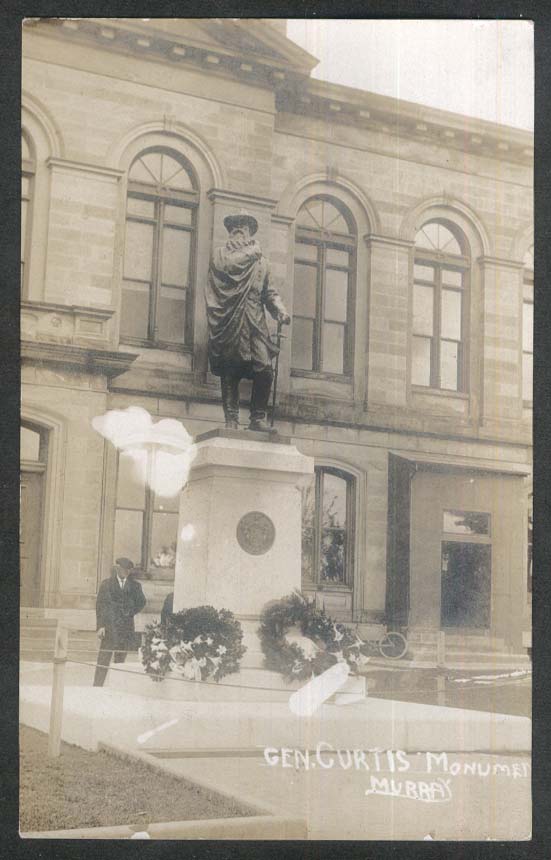
A great badge from the unveiling of the statue of MOH winner General Newton Martin Curtis in Ogdensburg, New York held in 1913. The hanger has two crossed US flags. The seal of the St. Lawrence Veterans Association between the flags. Written on the hanger is "1913 Annual Encampment - St. Lawrence Veterans Assn.". A red, white, and blue ribbon is attached to the hanger. Written on the ribbon is "1861 - 1865 - Sept. 30 - Oct. 1 & 2, 1913". The drop is attached to the ribbon. Written on the drop is "Unveiling of the Statue General N.M. Curtis - Ogdensburg, N.Y.". The photo below is not included in the sale.
Civil War Union Major General Newton martin Curtis was a Congressional Medal of Honor Recipient and an US Congressman. Born in De Peyster, New York, he was a teacher at Gouverneur Wesleyan Seminary and postmaster of De Peyster, at the outbreak of the Civil War. Commissioned a Captain, he was in command of Company G, 16th Regiment, New York Infantry, Union Army. Serving with distinction he fought in many campaigns and rose to the rank of Brigadier General in command of the 1st Brigade, 2nd Division, X Corps. In January 1865, his brigade was at the second Battle of Fort Fisher, North Carolina. General Curtis, leading his men was the first man to pass through the stockade. He personally led each assault on the traverses and was wounded four times. For his actions, he was brevetted Major General on of US Volunteers on March 13, 1865 and awarded the Medal of Honor. After the war, he was appointed collector of customs for Oswegatchie, New York, in 1866 and was special agent of the US Treasury Department, (1867-80). He was employed by the Department of Justice, (1880-82) and a member of the New York State Assembly, (1884-90). In 1891, he was elected as a Republican to the Fifty-second Congress to fill the vacancy caused by the resignation of Leslie W. Russell, reelected to the Fifty-third and Fifty-fourth Congresses, serving until 1897. Not a candidate for re-nomination, he was Assistant Inspector General of the National Home for Disabled Volunteer Soldiers, until his death at age 74 in New York City.
21 New York Cavalry - Griswold Light Cavalry - 1892 Reunion Badge
Item #: 12740
Click image to enlarge
A nice badge worn by veterans of the 21st New York Cavalry - Griswold Light Cavalry- at their 1892 reunion held in Owego, New York. The badge has a metal hanger with a brass color. A yellow ribbon is attached to the hanger. Written on the yellow ribbon in black ink is "Seventh Annual Reunion of the 21st New York - Griswold Light Cavalry - Oswego, N.Y. - July 20 and 21, 1892.". Crossed saber entangled with a wreath is in the middle of the badge. Metal fring is attached to the ribbon. The ribbon is approximately 8 1/4 inches by 2 1/2 inches. There is a brown spot over the sabers, under the York in New York.
Twenty-first New York Cavalry. — Cols., William B. Tibbits, Charles Fitz Simmons; Lieut. -Col., Charles Fitz Simmons; Majs., Charles G. Otis, George V. Boutelle, John S. Jennings. The 21st, known as the Griswold Light Cavalry, was recruited in the summer of 1863, in the counties of Rensselaer, Albany, Tioga and Monroe. The companies rendezvoused at Troy, where they were mustered into the U. S. service from Aug. 28, 1863, to Jan., 1864. A large portion of this regiment was mustered out by detachments and the remainder was consolidated on Sept. 9, 1865, into a battalion of seven companies, which was mustered out by detachments at Denver, Col., and Fort Leavenworth, Kan., from June 23 to Aug. 31, 1866. Five companies left the state on Sept. 4, 1863; one on Sept. 19; three on Oct. 19; one in November, and the others in Feb., 1864. The advance of the regiment served in the Department of Washington until Jan., 1864, when it was assigned to the 1st brigade, 1st cavalry division, Army of West Virginia. It was at Remount camp, Md., from Aug. to the close of Oct., 1864, then joined the Army of the Shenandoah and was assigned to the 1st brigade, 2nd cavalry division. Its last active service was in the Department of West Virginia, from March, 1865. Throughout the year 1864, it was constantly employed in the arduous duties devolving on the cavalry arm of the service. Its greatest casualties were sustained at Lynchburg, loss 13; Buckton, loss 18; Purcellville, loss 21; Snicker's gap, loss 37, Ashby's gap, loss 28; Winchester, loss 21; Cedarville, loss 10; White Post, Va., loss 25. In 1865 it took part in engagements near Paris, Loudoun county, Va., White Post and near Berryville, where it was in action for the last time. Altogether it lost 3 officers and 63 men killed and died of wounds; 1 officer and 78 men died of disease, accidents, in prison, etc.; total deaths, 145. Capt. William H. Mitchell was killed in action at New Market, Va.; 1st Lieut. Nelson B. Holcomb died of wounds received in action at White Post, and 2nd Lieut. Charles H. Cone was killed in action at Ashby's gap.
Footnotes: Regimental history taken from "The Union Army" by Federal Publishing Company, 1908 - Volume 2
A beautiful badge worn by veterans of the 97th New York Infantry at their 1904 reunion held in Utica, New York.
The badge has a metal hanger with a strip that says "MEMBER". The hanger is attached to a yellow ribbon.
Written on the yellow ribbon is "Thirty-Eighth Annual Reunion 97th Regt. N.Y. Vols - Oct. 12th, 1904 - Utica, N.Y.".
A large celluloid is attached to the middle of the ribbon. A photo of Captain A.B. Snow is on the celluloid.
Captain Archibald B. Snow was wounded at Gettysburg and was captured at the Weldon's Railroad, Virginia.
The badge was made by the Baltomore Badge and Novelty Company, Baltimore, Maryland as noted on the back of the badge.
97th Infantry Regiment Civil War Third Oneida; Boonville Regiment; Conkling Rifles
History
Mustered in: February 18, 1862 Mustered out: July 18, 1865
The following is taken from New York in the War of the Rebellion, 3rd ed. Frederick Phisterer. Albany: J. B. Lyon Company, 1912. This regiment, Col. Charles Wheelock, was organized at Boonville, and there mustered in the service of the United States for three years February 18, 1862. In May, 1863, it received by transfer the three years' men of the 26th Infantry; June 7, 1864, the men of the Sad Infantry, not mustered out with their regiment, and August 10, 1864, 103 men of the 94th Infantry. At the expiration of its term of enlistment, the men entitled thereto were discharged, and the regiment retained in service. The companies were recruited principally: A and C at Boonville; B in Lewis county; D and F at Salisbury; E at Prospect and vicinity; G in Herkimer county; H at Utica and Lowville; I at Little Falls; and K at Rome. The regiment left the State March 12, 1862; served in General Wadsworth's command, Military District of Washington, from March, 1862; in 2d Brigade, 2d Division, Department of Rappahannock, from May, 1862; in 1st Brigade, 2d Division, 3d Corps, Army of Virginia, from June 26, 1862; in 1st Brigade, 2d Division, 1st Corps, Army of Potomac, from September 12, 1862; in 3d Brigade, 2d Division, 1st Corps, Army of Potomac, from December, 1862; in 2d Brigade, same division and corps, from May, 1863; in same brigade and division, 5th Corps, Army of Potomac, from March, 1864; in 2d Brigade, 3d Division, 5th Corps, from May 9, 1864; in 2d Brigade, 2d Division, 5th Corps, from May 30, 1864; in 2d Brigade, 3d Division, 5th Corps, from June 6, 1864; and it was honorably discharged and mustered out, under Col. John P. Spofford, July 18, 1865, near Washington, D. C. During its service the regiment lost by death, killed in action, 7 officers, 97 enlisted men; of wounds received in action, 5 officers, 73 enlisted men; of disease and other causes, 1 officer, 156 enlisted men; total, 13 officers, 326 enlisted men; aggregate, 339; of whom 54 enlisted men died in the hands of the enemy.
The following is taken from The Union army: a history of military affairs in the loyal states, 1861-65 -- records of the regiments in the Union army -- cyclopedia of battles -- memoirs of commanders and soldiers. Madison, WI: Federal Pub. Co., 1908. volume II. Ninety-seventh Infantry.—Cols., Charles Wheelock, John P. Spofford; Lieut.-Cols., John P. Spofford, Rouse S. Eggleston; Majs., Charles Northrup, Rouse S. Eggleston, Delos E. Hall. The 97th, called the Conkling Rifles, was recruited in Oneida and Herkimer counties and mustered into the U. S. service at Boonville, Feb. 19, 1862, for a three years' term. It left for Washington on March 12; was quartered at Fort Corcoran as part of Gen. Wadsworth's command until May, when it was assigned to the 2nd brigade, 2nd division, Department of the Rappahannock and moved into Virginia, where it occupied various posts in the neighborhood of the Rappahannock river; was engaged at Cedar mountain, and lost 111 in killed, wounded and missing in the Manassas campaign. On Sept. 12, the regiment, which had served with the 3d corps, was assigned to the 1st corps and fought in the 1st brigade, 2nd division at South mountain and Antietam, suffering in the latter battle the most severe loss of any battle of its service—24 killed, 74 wounded and 9 missing. At Fredericksburg the regiment was prominently engaged, but not at Chancellorsville in the following May. It marched with the corps to Gettysburg and distinguished itself by the brilliantly executed capture of the colors of the 20th N. C. and 382 prisoners'. On the southward march it was present at Bristoe Station, and was in the Mine Run movement. While in camp at Brandy station, a sufficient number reenlisted to secure the continuance of the 97th in the field as a veteran regiment. In June, 1864, it was joined by the veterans and recruits of the 83d N. Y. infantry and in August, by the 94th, the 26th N. Y. having already been added to it in May, 1863. During Grant's famous campaign the 97th served in the 3d and 2nd divisions, 5th corps. Its heaviest losses during this campaign and subsequent operations were in the Wilderness, at Spottsylvania and near the Weldon railroad, but it shared in other engagements Of the brigade at the North Anna river, Totopotomy, Cold Harbor, White Oak Swamp, before Petersburg, in the Hicks-ford raid and the Appomattox campaign. It was mustered out near Washington, July 18, 1865, having lost dulring service 182 by death from wounds and 157 by death from accident, imprisonment or dis-ease, of whom 54 died in captivity.
Archibald B. Snow
Residence was not listed; 26 years old.

Enlisted on 1/27/1862 at Boonville, NY as a Private.

On 2/18/1862 he mustered into "I" Co. NY 97th Infantry
He Re-enlisted on 1/4/1864
He was Mustered Out on 7/18/1865 at In The Field, VA


He was listed as:
* Wounded 7/1/1863 Gettysburg, PA (Shot in face)
* POW 8/18/1864 Weldon Railroad, VA
* Paroled 2/15/1865 (place not stated) (Estimated day)


Promotions:
* 1st Sergt 4/15/1863
* 1st Lieut 6/1/1863
* Capt 6/15/1865 (Not Mustered)


Other Information:
born 1/30/1841 in Boonville, NY
Member of GAR Post # 97 (Wheelock) in Boonville, NY


(Father: S.E. Snow. Wife: Jennie Muller.  Children:
 Archibald, Martha)

After the War he lived in Oneida County, NY

Sources used by Historical Data Systems, Inc.:

 - New York:  Report of the Adjutant-General 1893-1906
 - Descriptive Work on Oneida County, NY
 - Photo Courtesy of New York State Military Museum
(c) Historical Data Systems, Inc. @ www.civilwardata.com
Cash, Check, Money Order, and PayPal We now accept PAYPAL for those of you who would like to use credit cards! Please send to vann@veteransattic.com .
Your satisfaction and happiness is our major concern. We will be glad to refund your purchase price if you are not happy with your purchase if returned within fifteen days of your receipt.
You can order through our web site or you can call 803-431-1798 for your order. Sales are complete when we confirm items are still in stock.






 Antietam